Allì, sin ser un lugar determinado, ni aleatorio; Como el puro ser donde no hay nada: Pablo Dávila
"Unborn and undying,
Neither permanent nor annihilated
Neither the same nor different,
Neither coming nor going."
The Eight Negations, Nāgārjuna, Mūlamadhyamaka-kārikāT H E P I L L® is thrilled to present Mexican artist Pablo Dávila’s first solo exhibition in Paris, opening on October 18, 2025. Titled Allì, sin ser un lugar determinado, ni aleatorio; Como el puro ser donde no hay nada [There, a place neither precise nor random; Like pure being where there is nothing], the exhibition presents a series of material propositions exploring the phenomenology of space through emergent forms perceived as events appearing in time and space.
Drawing inspiration from the Buddhist philosopher Nāgārjuna’s concept of the emptiness of all things, Dávila approaches space as a conceptual imputation: a name we give to relational potential in the absence of direct contact. Far from a nihilistic notion of non-existence or deprivation, this understanding of emptiness articulates the interconnectedness of all things, the incessant flux of phenomena, and how human thought and life emerge interdependently within both natural and social worlds.
Each sculpture in the exhibition enacts a different facet of space as emptiness, relation, and impermanence, rehearsing time-space events through a form of negative thinking. Beyond their immediate material presence, Dávila’s artistic gestures lie in setting the temporal and spatial parameters for contingencies of sound, rhythm, and movement—conditions through which events arise as perceptible phenomena.
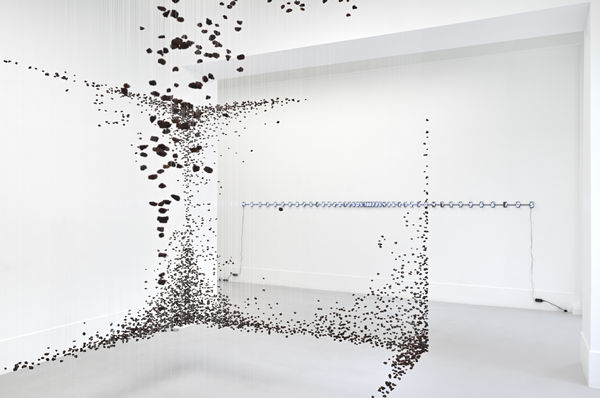
In Encuentran Un Lugar En El Mundo (Y Dudan En Otro Mundo) [They Find a Place in the World (And Doubt in Another World)], an ever-shifting soundscape of radios tuning in and out of frequencies renders space audible as a field of relational flux, materializing relational phenomena such as interference, emergence, and disappearance as processes of dependent arising. Esperan En Lugares Donde Viven Mientras Esperan [They Wait While They Live Where They Wait] proposes a speculative cube, perceptible only through the void between thousands of suspended elements held in tension with open air. Designated by Dávila as a “thing” only insofar as it unravels in the viewer’s mind, the work suggests a geometry of waiting—being held by emptiness. Connecting the exhibition to cosmic time and to the conditions of our existence, El Escenario Se Coloca y Se Retira [The Stage Is Set And Removed] offers a countdown centered on the Sun’s current age and the time remaining from its projected lifespan: We are contained within a duration that also fades. The cosmic stage is set, and then withdrawn.
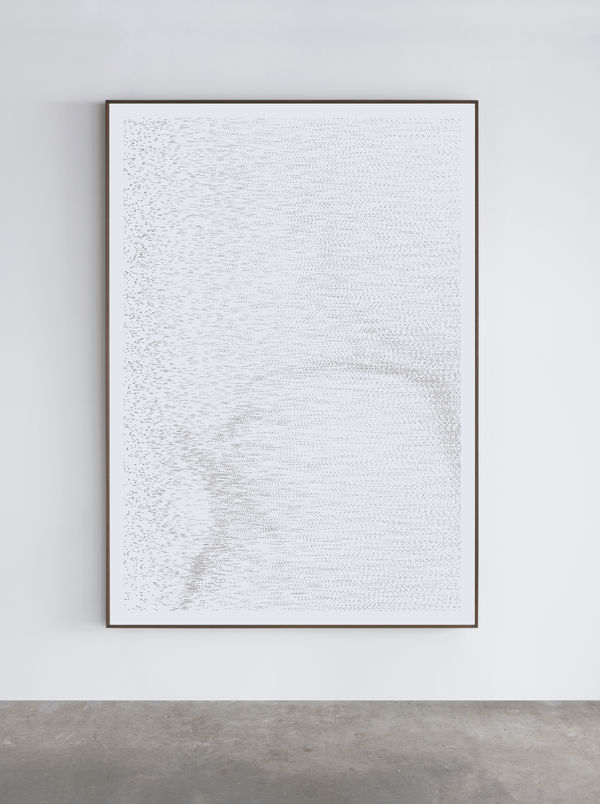
Taking inspiration from the Voyager and Pioneer spacecrafts of the 1970s, which were launched into outer space with the intention of communicating with possible extraterrestrial life forms, the data presented in the series Instructions to / from the Center of the Universe positions the Earth and our solar system relative to pulsars—neutron stars that emit beams of electromagnetic radiation at a steady rhythm. Extending our relative position into a language readable at the scale of the wider universe, Dávila’s work translates the coordinates of human existence into cosmic syntax.
"Space is neither a substance nor a void.
It arises dependently, is designated conceptually, and lacks inherent nature.
Space is not a self-existing container. It exists only in relation to what it allows—
movement, separation, rest, extension, distance.
In this way, space is like other “empty” phenomena:. It is the condition for the possibility of things appearing, but not a "thing" itself.
It cannot be said to be born or to die.
It doesn’t move or stand still.
There are no "things" here, only events. There is no definitive form, only conditions.
And in that absence, perhaps something more subtle appears: not what is, but what arises because it is not."
Pablo Dávila
Pablo Dávila’s interests and series of works are a constant exploration into space and time consciousness. Informed by science, music, poetry, cognitive sciences and physical phenomena, his works delve into notions of perception, the fleeting nature of time and historical interpretations through forms that are both pared-down and charged with sensorial immediacy. Exploring sentience and subjectivity through an ongoing investigation into perception, time, and spatial consciousness, his practice encompasses a multiplicity of media such as video, sound, electronics, installation, photography, painting, and site-specific interventions. Dávila constructs environments where perception itself hovers between cognitive understanding and sensory disorientation. His meditative yet incisive approach situates him within the tradition of Latin American conceptualism, offering a subtle critique of how technological regulation and codes of language interact with embodied perception.
Pablo Dávila (Mexico City, 1985) lives and works in Mexico City. Dávila studied film at Vancouver Film School (Canada). His recent solo exhibitions include Time Moves In One Direction, Memory In Another, MAH Genève (Geneva, 2023); It Comes Out Of Thin Air, Spreads, Shifts, Becomes Something Else, OMR (Mexico City, 2023); Please Call If Anything’s Unclear, THE PILL (Istanbul, 2022); Under one lamp by the day, billions by night, THE PILL (Istanbul, 2019); Ladies & Gentlemen, We Are Floating In Space, CULT Aimee Friberg Exhibitions (San Francisco, 2016). Selected group exhibitions include Still Alive, Aichi Triennale cur. Tobias Ostrander (Nagoya, JP, 2022); INDEX, Museo Marco (Monterrey, MX, 2022); Form Follows Energy, OMR – Lago / Algo (Mexico City, 2022); OTRXS MUNDXS, Museo Tamayo (Mexico City, 2020). Dávila has participated in the Atlantic Center for the Arts residency with Josiah McElheny (2016, Florida, USA).


-
 Pablo Dávila
Esperan en lugares donde viven mientras esperan, 2025 -
Pablo Dávila
Instructions to / from the center of the universe, 2025
-
Pablo Dávila
Phase Painting (Wind), 2024 -
Pablo Dávila
Instructions to / from the center of the universe, 2025 -
Pablo Dávila
El escenario se coloca y se retira, 2025
-
Pablo DávilaEncuentran un lugar en el mundo (y dudan en otro mundo), 2025